How to play Garba, even if you have never tried.
Garba is danced in a circle, and the circle carries you. Learn one step, watch for a minute, then join in. Here are the steps worth knowing, how the circle works, and how Garba differs from dandiya raas.
How the Garba circle works
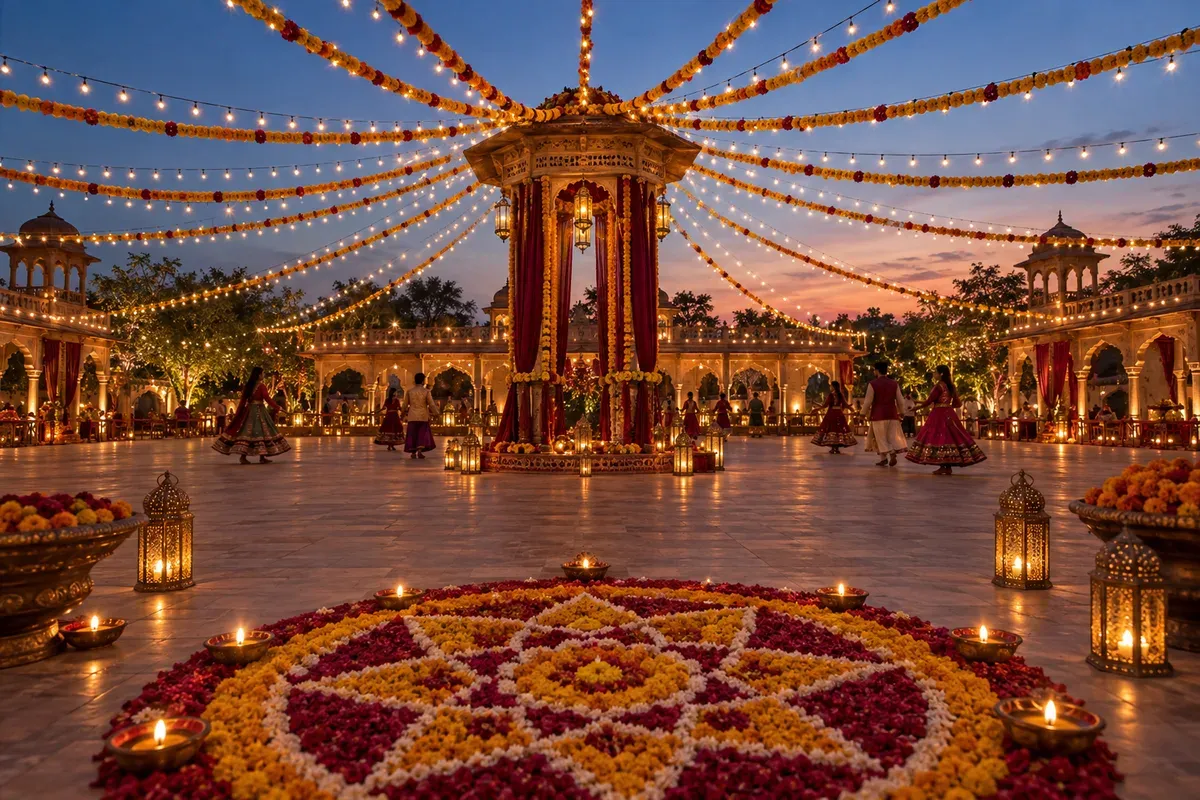
Garba is danced in a circle around a lamp or an image of the goddess. The name comes from the garbo, a clay pot with a lamp inside that traditionally sits at the centre. Everyone moves the same way round, repeating the same step to the beat, and on big grounds there are several circles, one inside the other, each at its own pace.
Traditionally, Garba comes first in the evening and dandiya raas follows. Many grounds now mix the two all night.
The steps worth knowing
-
Be Taali બે તાળી
The two-clap step most people learn first. Step, step, clap, clap, and keep moving with the circle. If you know only one step, know this one.
-
Tran Taali ત્રણ તાળી
Three claps per cycle, a little quicker and bouncier. Once the music picks up, most of the circle switches to this.
-
Dodhiyu દોઢિયું
A faster, springier step with a sway and a turn. It looks effortless on the good dancers, and it is where a partner who matches your pace really helps.
-
Dandiya Raas દાંડિયા રાસ
Danced with a pair of decorated sticks, facing a partner who changes as the lines move. Bring your own dandiya, and a partner who will not miss a beat.
Your first round
- Practise Be Taali at home to one Garba song until your claps land on the beat without thinking.
- At the ground, stand at the edge and watch one full turn of the circle before you join.
- Slip in behind someone whose pace you like, and copy them.
- Keep moving with the circle. If you need a break, step out to the outside instead of stopping inside it.
- When the music speeds up, most of the circle switches to Tran Taali. Follow the person in front of you.
- Go with someone who knows the steps. A partner who matches your pace makes a first night far easier.
Garba vs dandiya raas
| Garba | Dandiya raas | |
|---|---|---|
| Danced with | Your hands: claps and turns | A pair of decorated sticks |
| Formation | A circle around the lamp or the goddess | Two lines facing each other |
| Partner | Not needed; join the circle alone | You face a partner, who changes as the lines move |
| Best for beginners | Yes, start here | Once you are comfortable with the beat |
Ready for the nine nights? See the Navratri 2026 dates, the colour for each day and what to wear.
Find a partner who matches your paceGarba steps, answered.
What are the basic steps of Garba?
Be Taali, the two-clap step, is the one to learn first. Tran Taali adds a third clap and a little more speed, and Dodhiyu is a faster, springier step with a sway and a turn. Dandiya raas is danced with sticks, facing a partner.
What is the difference between Garba and dandiya?
Garba is danced in a circle with claps and turns, and you can join alone. Dandiya raas is danced with a pair of decorated sticks, in two lines facing a partner who changes as the lines move. Many grounds play both through the night.
Can a beginner play Garba?
Yes. Learn Be Taali, watch the circle for a minute, then join behind someone and copy their pace. Most circles are full of people who learned exactly this way.
Why is Garba danced in a circle?
Garba is danced around the lamp or image of the goddess at the centre. The name comes from the garbo, a clay pot with a lamp inside. A circle also means anyone can join or leave at any point.
Do I need a partner for Garba?
Not for Garba itself, which is danced in a circle. For dandiya raas you face a partner, and many people simply enjoy going with someone who matches their pace. Play Garba helps you find one going to your ground on your night.
Know Be Taali? You are ready.
Find someone going to your ground on your night. Choose “Just a Garba partner” if dancing is all you are after.
Going with friends? Get them on it too.
No app store needed. Open Play Garba in your browser and add it to your home screen.